Northern Advocate Column

The discordant hot pink of the Taiwanese cherry

7th August 2021

It’s one of those drizzly, grey Whangārei mornings. I’m driving to work, heading down the Kamo bypass, flicking the wipers on intermittently to sweep aside the water droplets collecting on the windscreen in enough density to be annoying. The road makes a slow arc to the right, so my vision falls on trees and scrub on the left side of the road. A mass of khaki green that hardly registers in the dull light—and then bursts of vibrant hot pink. The Taiwanese cherry trees are flush with flowers.

Maybe it’s the gloomy day. Maybe it’s my mood, but the contrast of the hot pink up against a dark background is startling. However, my initial appreciation is quickly tempered. Because I know the Taiwanese cherry is an invasive species, an escapee from suburban gardens on the run in our native forests. Some conservationists argue it needs to be eradicated. So if it’s beauty I’m seeing, it’s a tainted beauty. No fault of the cherry trees, they’re just doing what a plant does, trying to grow and reproduce.

When I’ve previously thought about these trees, at this time of year when they burst into flower, I’ve concluded that the hot pink is not to my taste. It’s a little too garish, the colour of marketing. If I were to design an aesthetic landscape that contrasted the darkness of the New Zealand bush with a prolific flowing tree, I’d prefer a whiter shade of pink. More like the Japanese cherry blossoms planted along George Street in Hikurangi. They would be a more subtle intrusion into the landscape, like the colour of a young girl’s frilly pink dress, not the hot pink leotard these Taiwanese cherries are wearing.

The road swings around, and I approach the bridge (Station Rd) that goes over the bypass. On the verges either side, framing the bridge, are more cherry trees and the bright yellow of flowering gorse. Two invasive species going toe-to-toe, doing a good job of blocking out any other plant from getting a look in. Continuing my drive, I’m noticing hot pink everywhere, especially along Western Hills Drive. The Taiwanese cherry is altering the look of the town.

Do I wish them gone? It might be possible to chop down or poison every last one, but would there be enough public pressure, or interest, for this to happen? It’s easily argued there are more pressing things to worry about and devote resources to. Yet, the tree is crowding out native plant species that provide food all year round for our native birds. The Taiwanese cherry—interloper that it is—only offers a food source for a few brief weeks.

Pondering this tree and what to do or not do about it, I realise that we’re not in control. Despite the obvious impact of the human species on the planet and our spilling of nature’s bountiful seed-box across continents, we’re not in charge. There’s some consolation in accepting this. Nature will find its way, with or without us. Nature certainly doesn’t care what we think. Nature is brutally amoral.

After parking the car on Second Ave, I walk, head down, to work in the rain, still thinking about the cherry trees and the possibility of them being the subject of this column. Then, at my feet, I slowly register dots of pink on the footpath. They’re tiny and spread out, like a giant had flicked a paintbrush up in the sky and scattered drips all along the path. I turn around. Sure enough, right by where I’ve parked the car is a large Taiwanese cherry in all its vibrant, invasive, lurid, natural and discordant glory.

Standard
Northern Advocate Column

GST on new build homes means people are borrowing to pay a tax

13th March 2019

I want to open up another front in New Zealand’s “great tax debate” of 2019, it’s the 15% GST on new build homes.

Consider a new home advertised on the market for $600,000. Included in that price is GST of $78,261. The tax is collected by the property developer on behalf of the government, but is paid by the end consumer, the owner-occupier of the home. That’s a big chunk of tax. Worse, a first home buyer taking out a mortgage is going to be borrowing to pay it. Say you manage a $50,000 deposit, leaving $550,000 to pay back to the bank over 30 years. The GST component of your outstanding debt will be $71,739. Taking ASB’s current floating interest rate of 5.8%, you would be paying $79,796 in interest on the GST alone. More than double the original tax calculated on the value of the home. Your tax bill has effectively ballooned to  $158,000. The extra eighty grand doesn’t go to the government, of course, it’s more income for the bank. 

That’s the scenario for a new build, but it doesn’t stop there. Old houses are renovated, extended and maintained over time. Homeowners pay GST on building materials and labour by plumbers, chippies, electricians, etc. The GST incurred will be factored into the asking price when people sell.

It’s also true that GST on new builds has an influence on the price of all homes. The seller of an older home next door to a new build which has 15 per cent taxed on to the asking price has room to ask for more for the house they’re selling. A degree of market equalisation across new builds and existing homes is going to take place. 

It’s reasonable to conclude that GST on new builds, as well as GST on work done on existing homes, is contributing to all homes being more expensive. The mortgage payments of Kiwis are therefore higher, and the profits of the big four Aussie banks which dominate mortgage lending that much greater. International shareholders of those same banks are, I’m sure, grateful for our largesse. 

You’d think this would be national outrage, but there’s complete silence. The final report by the Tax Working Group rejected making any exemptions to GST. Even though exemptions and variable rates are the norm for countries that have a goods and services tax. New Zealand is the odd one out.

Defenders of GST tell us that it’s simple and shouldn’t be tampered with. That’s its beauty, they say. Perhaps banks can appreciate its beauty, but working your arse off to pay a mortgage that includes substantial interest on a tax, seems the most ugly of taxes to me. It’s fundamentally unjust to have to borrow to pay a tax. That goes for houses, but also cars, washing machines, funerals, and any other item people are forced, out of necessity, to borrow for. 

Here’s a challenge, then. Maybe all the politicians, columnists and media pundits horrified at the thought of having to pay tax on capital income, could summon the same outrage for GST’s impact on the unaffordable housing market. They might want to look at Britain, where their goods and service tax doesn’t apply to building materials and labour on new properties. Or they might refer to the GST rebate Canada has recently introduced to lower the price of new homes. Or perhaps we don’t have to look to overseas examples and conclude for ourselves that GST is a mongrel of a tax.

Borrowing to pay tax, when some people are making fortunes and not paying tax, just shows how obscenely weighted in favour of capital wealth our tax system is. 

Standard
Northern Advocate Column

Elvis, ten of the best

9th July 2022

The Elvis movie directed by Baz Luhrmann plays fast and loose with the truth of Elvis Aaron Presley’s life. Does it matter? Stardom, like hero worship down through the ages from Achilles to Joan of Arc, has never been limited by the facts of a life. Or even if the hero actually existed. The movie continues that tradition of myth-making. 

More important to me than the myth or knowing the flawed man behind the star image, was simply Elvis’s voice, his supreme gift. Here’s my selection of ten essential Elvis performances that utilised that gift:

That’s All Right (1954)

The beginning. Sam Phillips’s Sun Studio, with Scotty Moore on electric guitar and Bill Black on upright acoustic bass. A blues song by Arthur Crudup infused with country rhythm and swing. Elvis sings “all right” about ten different ways, showing off all the recognisable Elvis vocal mannerisms. They’re cliches now, but they must have sounded fresh and original back then. The track was a sensation when first played on a Memphis radio station. Listeners rang up demanding it be played over and over. 

Blue Moon (1956)

On all the tracks Elvis recorded at Sun Records, he sounds like no one before him. These recordings are a bomb going off in the tradition of popular music. His version of ‘Blue Moon’ sounds like he’s singing from outer space. It’s truly weird when he falsettos an elongated “blue” into something primitive and otherworldly. The rarefied soundscape has a lot to do with Sam Phillips’s “reverberation technique” that gave the early Elvis records a big echoing sound.

My Baby Left Me (1956)

Few Elvis impersonators have attempted this song. It’s surprisingly high-pitched. You can hear a sonic trajectory that goes from this to Robert Plant’s blues wailings in Led Zeppelin. Plant was inspired by African American blues singers, but he was also a big Elvis fan. 

Heartbreak Hotel (1956)

The definitive early Elvis song. Being lonely has never sounded so good, so sexy. When he gets low and slow in that stuttering vocal, it made the girls scream. It’s the song most people choose if they want to impersonate Elvis. I can do a pretty good version myself. The minimalism of the music accompaniment, that tinkling piano and big bass notes, gives the song a texture that, contrary to the song’s lyrics, helps make Heartbreak Hotel a place you want to be.

You’ll Never Walk Alone (1967)

There are some good performances on Elvis’s post-army records, even the ones accompanying some of those awful movies. However it’s his gospel recordings during the sixties where he’s most passionate and committed. It’s hard to pick a favourite, but I’ll go with ‘You’ll Never Walk Alone,’ which was a Rodgers and Hammerstein show tune that Elvis turned into a gospel song. He’s singing like a man who knows what it’s like to be lost. His performances of ‘How Great Thou Art’, ‘Amazing Grace’ and ‘Milky White Way’ are equally moving. I’m not remotely religious, but I’d listen to these songs in a beautiful church and probably cry.

Tomorrow Is Long Time (1966)

A cover of a Bob Dylan song. Elvis heard the song via an Odetta album of Dylan covers. The way Elvis sings it, with restraint and simplicity, in a mournful tone, slows down time. The song lasts 5 minutes and 18 seconds, but it seems much longer, with tomorrow never reached. 

If I Can Dream (1968)

To fully appreciate ‘If I Can Dream’, you have to watch Elvis’s performance that concluded his NBC television special of 1968. This is rock stardom presence with bells on. His movements are somehow awkward and incredibly cool at the same time. Elvis is both church preacher and snake oil seller at a travelling circus. Either way, you can’t help believing, such is the performance. There’s a growl in his voice on this plaintive song that’s rare.

Suspicious Minds (1968)

Rejuvenated by the 68′ Comeback Special and free from movie contracts, Elvis headed to Memphis to record what many people think is his best album. The sessions produced the wonderful ‘Suspicious Minds’. To my mind, his vocal is effortless – a word that best describes Elvis’s singing at its most sublime. The song’s protagonists are stuck in a trap, while Elvis’s voice is stuck in an irresistible groove.

An American Trilogy (1971)

This song montage takes me back to being a young child exposed to Elvis through my dad playing one of his greatest hits albums. I didn’t understand what ‘An American Trilogy’ was about. It just sounded important. An ascending operatic movement of sadness and emotional release. A deep mystery to a child’s ears. 

My Way (Live, 1977)

In the 1981 documentary film, ‘This Is Elvis’, the movie’s makers include footage of Elvis in his final days on stage singing ‘My Way’. He’s fat, bloated, sweating profusely, looking ridiculous in a tight-fitting jumpsuit. Even though his body is deteriorating, his voice retains some of that effortless quality. He puts everything into the performance, knowing surely that he soon faces the “final curtain”. It’s tragic and sad, yet defiant of life’s struggles and ultimate absurdity. This is the conclusion of Elvis’s American Dream. 

Standard
Northern Advocate Column

Letter to Sam Hunt

25th August 2018

Hi Sam, 

Hope you’ve stumbled well through the worst of winter. Almost there now, the onion weed’s in bloom. A beauty that can be overlooked, but not if you’re looking. I know you will be. 

A good description of your poems, if you don’t mind, like “onion weed.” Smallish, delicate, but hardy; bloody difficult to remove from the garden. Keep popping up amongst the C K Stead daffodils, the Hone Tuwhare orchids, the Fleur Adcock dahlias. A fine garden that.  

It’s a pity, don’t you think, that the kids aren’t digging R A K Mason anymore. Though mine really like Ella Yelich-O’Connor (aka Lorde). Poetry survives in one form or another. 

Evon rang me last week to tell me you had another book out. I went to the bookshop in my lunch break to have a look. Great title, Coming To It, double-edged.  

Another selection across the years I see, with some new ones thrown in. I like how you refuse to put them in their order of age, from earliest poem to most recent. Keeps you guessing that way, and the poetry fresh, like hanging out with young people can be good for old bones. 

How old are you now as the crow flies? Not counting all the detours, the ancient beginnings and past endings. Sappho, she was 2,648 this year. Yeats, would you believe it, 153. 

And what are you making of the common newsy world? I heard a new fibre optic cable came ashore at Mangawhai, on the opposite coast to you. (You’ve always known which coast to choose, what to avoid). 

This cable will be bringing us the world. Sometimes wish I could disconnect completely, go fishing. If I did maybe I’d catch more poems. We risk knowing too much to ever understand. 

I hope that for you the fishing on the Kaipara is good. The warmer weather will help, the big ones will come into the shallows. 

Just for fun, I’m writing on an old typewriter I found at the SPCA shop for $20. It really bangs. The apostrophes drop on to the page like bombs from an old B-52. 

With all the mistakes and banks of xxxxxxxxx building up, I feel like a Kerouac typing On The Road or a Dylan thumping out sleeve notes above the Café Espresso in Woodstock. Oh the delusion!  

He’s playing here again soon — are you going? I guess he’s turned himself into Ovid now, when he’s not doing Sinatra. I’m sure you’ve got Tempest. Have you seen the video of Early Roman Kings? It’s such a dag. 

Well, I’ll sign off now. Please excuse this public note. There is a back road to you, but I no longer know it.

It’s enough that these lines of yours mean something to me today: “When one of the Greats/ comes in amongst us/ Then we—guests/ eating from paper plates—/ Stand at the outmost circle,/ thank them for calling./ We have our Gods, and Fates:/ we honour them all;/ when we’re not out killing,/ we’re a humble people.”  

Written on the occasion of Sam Hunt’s latest collection of poems, Coming To It, being released to the world. Published by Potton & Burton. 

Standard
Northern Advocate Column

Ted Lassso and the difficulties of being nice

2 September 2022

The TV show Ted Lasso is a cross between Coronation Street and the eighties American sitcom Cheers, with football (don’t say soccer) thrown in. I’ve been watching episodes regularly on AppleTV+, though I wouldn’t say I was binging. Mainly because the incessant niceness of Ted Lasso, played by Jason Sudeikis, would make me queasy if I overindulged. There’s only so much kindness I can take on TV before I’m longing for Game of Thrones-level villainy and deception. 

Ted Lasso centres on an ex-college American football coach trying his hand at managing a fictional English football club, AFC Richmond. Even though he knows little about the sport. What he knows more about is getting players and everyone else to “believe” in themselves. And to be nice to each other. Because that’s the road to building team culture and maybe even success. 

The show has been credited for bringing kindness back to television. Which is all well and good, but it’s the humour and characters that make Ted Lasso watchable. Characters that exist around English football are lampooned and mined for hidden depths. Like Keeley, the famous-for-being-famous perennial girlfriend of football players. And my favourite character, Roy Kent, the over-the-hill hirsute star player who grunts at everyone and swears constantly. 

There’s lots of humour based on differences between American and British culture. Tea jokes abound. And there are references aplenty to pop culture that a viewer my age will get. It’s the kind of warm television viewing you need during a wet soggy winter. 

To keep a balance, it does go to some darker places, without which there would be no drama. We find out early on, for instance, that Lasso’s forever smiling, constantly jabbering optimism is one reason his wife gives for wanting to leave him. 

And being a show centred on high-level sport, niceness comes into conflict with the desire of fans and players to win games. However kind you are, it won’t mean squat if the team is losing. Comparisons with Ian Foster’s (Fozzie to his friends) reign as All Blacks coach are obvious. You can be a nice guy, who the players love, but if you’re losing, you’re the most hated man in New Zealand rugby.

In the exploration of kindness, Ted Lasso makes another more subtle point, which is all about the maths. If you’re kind to everyone, are you diluting the amount of niceness you’ve got for a more modest number of people? Is Lasso’s profligate niceness covering emotional issues with real intimacy? 

There’s also the impact of Lasso’s behaviour on other characters—what we might call the diminishing returns of niceness when the circle is wide. Here the story arc of Nate, who rises from kit manager to assistant coach, is revealing. The falling out with Lasso in Season Two is due partly to Nate feeling like Lasso isn’t being as nice to him as he was in the beginning. Lasso’s charm made Nate feel special, but then the friendship doesn’t develop into something deeper—Lasso is just nice to everyone. And as head coach he’s got a lot on his plate. For Nate, who misreads the dynamic, there’s hurt and jealousy. 

The regard that the less charismatic have for skilled people pleasers can create unequal relationships. Now I don’t know the ins and outs of everything currently happening inside the Labour Party caucus, but Dr Gaurav Sharma is acting to me a little like the character Nate. With Jacinda Ardern in the role of the kindness-preaching Lasso. 

One wonders, did Dr Sharma misjudge the Prime Minister’s natural charisma and empathy as something more than a party leader doing her job? Those photos with the Prime Minister were always going to mean more to backbencher Sharma than to Ardern. Dr Sharma appears to be acting like a man hurt, whatever issues he had with his own staff and the Labour Party whips. 

This leads me to another comparison that can be made with the TV series. Sharma wants people to be nice to him, even though he may not have shown exemplary kindness to others. Hardly a rare fault, however. All of us are prone to over-evaluating our kindness and being overly sensitive to rudeness, disrespect, or plain indifference shown towards us. 

One of the ideas raised by Ted Lasso is an old one, common to cultures, religions and philosophies throughout history. That it’s more important to be nice rather than worry about other people being nice to you, which is out of your control. Being nice is its own reward.

Recently I picked up a manual on being nice from an Op-Shop. The book has a turquoise cloth-bound cover with the title “On Being Nice” in a plain yellow font. It’s a publication of The School of Life, which has physical campuses around the world and a website.

I should get round to reading it. Some would say I could do with training in being nice. Depends on who you ask, though. There are interesting chapter headings: “Why We Don’t Really Want to Be Nice”, “Losers and Tragic Heroes”, “The Problem of Over-Friendliness”, “Why Kind People Always Lie”, and “The Charm of Vulnerability.” Sounds like all the stuff the Ted Lasso show is dealing with. 

What’s true, is that it’s not always easy trying to be nice. Even Kermit the Frog had his moments of meltdown. 

Standard
Northern Advocate Column

Building flimsy structures against the wind

4th September 2021

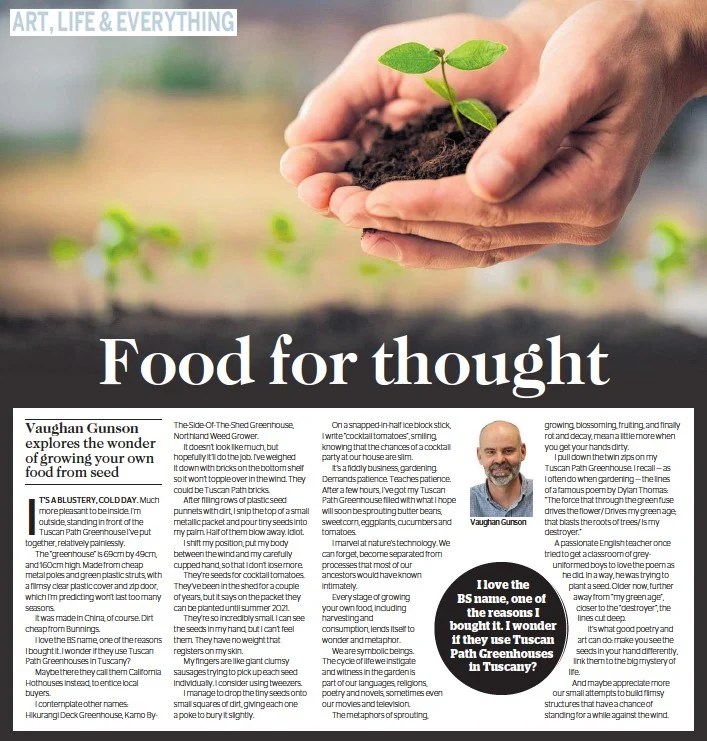
It’s a blustery cold day. Much more pleasant to be inside. Instead, I’m outside, standing in front of the Tuscan Path Greenhouse I’ve put together, relatively painlessly. The “greenhouse” is 69cm by 49cm, and 160cm high. Made from cheap metal poles and green plastic struts, with a flimsy clear plastic cover and zip door, which I’m predicting won’t last too many seasons. It was made in China of course. Dirt cheap from Bunnings. 

I love the bullshit name, one of the reasons I bought it. I wonder if they use Tuscan Path Greenhouses in Tuscany? Maybe there they call them California Hothouses, to entice local buyers. I contemplate other names: Hikurangi Deck Greenhouse, Kamo By-The-Side-Of-The-Shed Greenhouse, Northland Weed Grower. 

It doesn’t look like much, but hopefully it’ll do the job. I’ve weighed it down with bricks on the bottom shelf so it won’t topple over in the wind. They could be Tuscan Path bricks. 

After filling rows of plastic seed punnets with dirt, I snip the top of a small metallic packet and pour tiny seeds into my palm. Half of them blow away. Idiot. I shift my position, put my body between the wind and my carefully cupped hand, so I don’t lose more.

They’re seeds for cocktail tomatoes. They’ve been in the shed for a couple of years, but it says on the packet they can be planted up until summer 2021. They’re so incredibly small. I can see the seeds in my hand, but I can’t feel them. They have no weight that registers on my skin. My fingers are like giant clumsy sausages trying to pick up each seed individually. I consider using tweezers.

I manage to drop the tiny seeds onto small squares of dirt, giving each one a poke to bury it slightly. On a snapped-in-half ice block stick, I write “cocktail tomatoes”, smiling, knowing that the chances of a cocktail party at our house are slim. 

It’s a fiddly business, gardening. Demands patience. Teaches patience. After a few hours, I’ve got my Tuscan Path Greenhouse filled with what I hope will soon be sprouting butter beans, sweetcorn, eggplants, cucumbers and tomatoes. I marvel at nature’s technology. We can forget, become separated from processes that most of our ancestors would have known intimately. 

Every stage of growing your own food, including harvesting and consumption, lends itself to wonder and metaphor. We are symbolic beings. The cycle of life we instigate and witness in the garden is part of our languages, religions, poetry and novels, sometimes even our movies and television. The metaphors of sprouting, growing, blossoming, fruiting, and finally death and decay, mean a little more when you get your hands dirty. 

I pull down the twin zips on my Tuscan Path Greenhouse to close it up. Stepping back, I recall—as I often do when gardening—the lines of a famous poem by Dylan Thomas: “The force that through the green fuse drives the flower/ Drives my green age; that blasts the roots of trees/ Is my destroyer.” A passionate English teacher once tried to get a classroom of grey-uniformed boys to love the poem as he did. In a way, he was trying to plant a seed. 

Older now, further away from “my green age”, closer to the “destroyer”, the lines cut deep. It’s what good poetry and art can do: make you see the seeds in your hand differently, link them to the big mystery of life.

And maybe appreciate more our small attempts to build flimsy structures that have a chance of standing for a while against the wind. 

Standard
Northern Advocate Column

5 weeks delivering the morning paper

27th January 2018

The ad said earn some extra money over the holidays and get fit. Yep, I thought, both of those things would be good right now.

“Own car required to deliver newspapers in the morning.” I could do that. And it would be kind of amusing to be working both ends of the industry. “Here’s your paper… by the way, check out my column on page 5.” So I phoned the number and said I was interested. 

“We start at 1.30 in the morning.” Gulp, earlier than I expected. But since I’d talked it up so much with my partner I couldn’t back out now. “Fine,” I said. 

“It’s minimum wage plus an allowance to cover petrol.” “OK,” I replied, hoping it might have been more. 

The first morning was a training run. I was desperately tired at the end of it, as I hadn’t slept at all before the alarm went off. Having major second thoughts.

Next day I was on my own, delivering papers to the Riverside area of Whangārei and part of Onerahi, about 200 addresses. 

A difficult morning, as I struggled to find letterboxes in the dark and took a wrong turn, delivering papers to the completely wrong street. Still managed at least to get the papers delivered by 7am, before the phones started ringing. 

Because you get paid a piece rate, I’d effectively worked for less than minimum wage. The per paper payment is worked out by the average amount of time it’s supposed to take. At this stage I was sceptical. 

However, after a couple of days, and fewer mistakes, I saw that it was possible to do it on time, even quicker if I ran between the car and letterboxes. 

One of the things it was interesting to realise is how computers are speeding up tasks like newspaper delivery. Each morning we got a printed sheet with all the addresses in the exact order you should deliver them. Using Google Maps a computer programme has worked out the most efficient route.  

For the most part, things were going well, in the first week I only missed a few letterboxes and delivered an Advocate instead of a Herald once.  

When I started back at my normal day job after Christmas, however, boy was I tired. Some mornings I felt like giving up mid-run and lying on the back seat of the car to sleep. Please just let me close my eyes! 

The BP on Riverside Drive was my saviour on occasions, though it hurt to eat into what I was earning. I can say that a beef roll has never tasted as good as at 4am, feeling somewhat sorry for myself. A coffee was just heaven. 

Today was my last day, after five weeks. It will have felt good delivering this final paper. In the weeks ahead, when I wake up at a civilised time, hopefully I can spare a thought for the army of people in New Zealand who work through the night to do the things that, as consumers, we demand. 

On 1st April, newspaper deliverers, like tens of thousands of other hardworking Kiwis, will be getting a pay rise, with the minimum wage going up to $16.50 an hour. More increases are meant to follow, so that by 2021 the minimum wage will be $20 an hour. It’s the least the Government can do. 

To those delivering the papers in Whangārei this morning, I now have some understanding of the job you’re doing. Though not, it must be said, on a cold, wet winter morning. I was only a fair-weather and temporary colleague. Kia kaha. 

Standard
Northern Advocate Column

How do I get this possum killing done?

20 October 2018

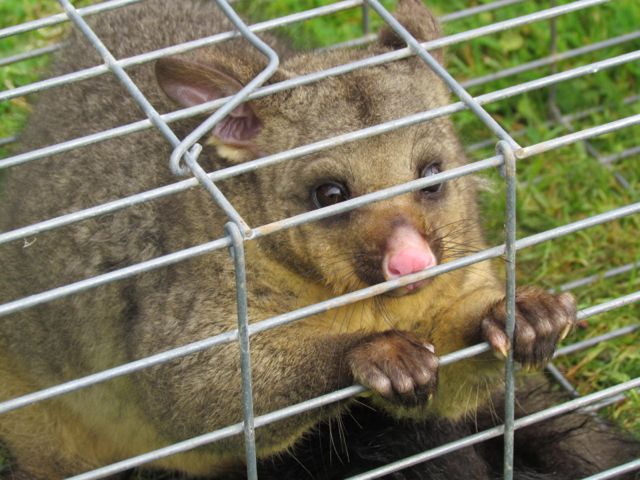
In my garden shed there’s a wire cage, a trap actually. I saw it for sale at the local second-hand market and thought, yep, time I did something about my possum problem. Singular, as far as I can tell, living in the neighbour’s Norfolk Pine. It scampers down at night and helps itself to the fruit trees. Or the tomatoes, like it did last summer. 

The trap sits in the shed unused, however, because of my dilemma: what do I do with the possum once I’ve caught it? Take it on a road trip? Like I remember my father—an animal lover—doing when I was young, and he had a similar backyard invader. Out of sight, out of mind, but hardly in the spirit of culling these destroyers of native bush.

I’m going to have to kill it. I should kill it. They’re pests, they deserve to die… Don’t they? 

But how should I do it? My mother-and-law, very matter-of-fact and practical about most things, says drown it. There’s a pond on the farm over the fence where this killing could be done. Just drop the caged animal into the water. It’s a shallow pond, not a lake, there would be lots of flailing and noisy splashing about. The suffering might be a little too much to witness. 

There is the hammer method. That’s how my rural-living, hunting and fishing cousin used to do it when he was trapping possums to make some pocket money. This was the early eighties when you could get good money for possum fur in New Zealand. As a kid, three years younger, I remember many occasions going into the bush to check gin traps, those terrifying rusty jaws of death (or so they seemed then). The trapped possum was dispatched with a viciously swung hammer blow to the head. I was in awe. My cousin always pressured me to have a go, but I never did. 

Could I do it now? Seems like plenty of room for error, I don’t want to be clumsily dealing multiple blows like some deranged Mr Bean. 

I have killed before. Many fish. A couple of sick chickens. And some ducks. We got the ducks for their eggs and to eat. Appleyards they were, good for both. After searching the internet for the most humane killing method, it was apparent guillotining the duck’s head with a cleaver was actually the best option, if you could stomach the blood. 

Cleaver duly purchased. Kids banished from the backyard, two big nails hammered into a piece of wood, neck quickly placed between nails and cleaver swung with a heavy heart. Truly, each time, I was sad for the rest of the day. We haven’t purchased any more ducks. 

I still have the cleaver. Could I chop the head off a struggling possum? I’ve visions of a horror scene… a half-decapitated possum clawing at my arm, blood everywhere, and me falling over the wheelbarrow screaming. Maybe not. 

There’s poisoning. Can you even buy 1080? It’s one thing to support 1080 drops done by faceless other people to faceless furry marsupials in a forest far away, but feeding poison to single animal through the bars of a cage? 

I shouldn’t be so squeamish. I’d be doing a good thing. No different to what DOC’s doing. They’re the good guys, right?

I read recently that the kererū, New Zealand’s bird of the year, has a lower population in Northland, in part because of possums. I like kererū. 

One way or another, this killing’s got to be done. Why do I keep hearing the lyrics to that Bob Dylan song in my head? (Abe said, “Where d’you want this killin’ done?” God said, “Out on Highway 61.”) Killing a possum isn’t the equivalent of a biblical infanticide. End this melodrama. 

I need to borrow a gun. I’ve never fired one before, they scare the hell out of me. But I’ve got to summon the moral gumption and just do it. Killing this damn possum will be good for the environment. 

I’ll do it for the kererū! 

For my tomatoes! 

Standard
Northern Advocate Column

Do Ardern and Labour have the courage to tax the wealthy?

13 May 2020

It seems like an age, but cast your mind back to Jacinda Ardern’s address to the nation on Sunday, March 21 announcing the Covid-19 response levels and preparing us for lockdown. You might have noticed a framed photograph of a man on the shelf behind the Prime Minister. It wasn’t there by accident, it was a deliberate placement of a symbolic visual cue. Of the kind Jacinda and her team are skilled at using. The photo was of Michael Joseph Savage, the first Labour Party prime minister. He came to power in 1935 in the middle of the Great Depression and on the back of mass civil disobedience and political agitation by worker unions and the unemployed.

What Savage and that first Labour government are most known for, is the Social Security Act of 1938, which secured a free public health system, the unemployment benefit and universal superannuation. The act was fiercely opposed by industry and newspapers of the day. But on the back of popular support, the first Labour government established a social contract with New Zealand citizens. The state would play a role in securing the wellbeing of all. Savage died 18 months later. He was genuinely mourned by Māori and working-class people.

Positioning Savage’s photo behind the Prime Minister’s shoulder suggested continuity between him and Ardern. The message was that this Labour-led government would also look after us in a time of crisis. They could have done more, and may still need to, but they’ve acted so far in broad accordance with the principles laid down by Labour in the 1930s.

What often goes unacknowledged, however, when looking back at the Michael Savage government, is that the social security spending was funded by a new tax surcharge. The rate was one shilling in the pound, or 5 per cent. Increasing taxes doesn’t quite capture the imagination. But if the 21st-century version of the Labour Party wants to claim continuity with the first Labour government, then they too will need to address the issue of tax.

Tomorrow, Finance Minister Grant Robertson will be delivering what he’s dubbed the “Recovery Budget”. The Budget will starkly present the Government’s ballooning expenditure, coupled with deflating revenue from GST, income tax and company tax. The shortfall will be covered by ramping up borrowing to levels never seen in New Zealand’s history. In the not-too-distant future, we’ll have to start repaying this mountain of public debt. Which means more tax.

With incomes for many of us falling – and the tax we pay falling simultaneously – where’s the extra tax revenue going to come from? It has to come from those New Zealanders who are hurting the least and can most afford it. Labour has backslid once on tax reform. Faced with opposition to a capital gains tax they folded. With Winston Peters perhaps playing a decisive hand. That was then, this is now. A fair response to paying off debt, while maintaining social spending, would be to increase tax on the wealthiest 20 per cent of New Zealanders. There will be opposition from the usual quarters. Though even some of our richest citizens must see the moral imperative of contributing more to the collective pot. Selfish opposition to extra taxes on wealth or higher incomes may not look good when so many have paid a high price to win against Covid-19.

The grounds of the debate have clearly shifted since a capital gains tax was knocked back. Heading into the September election, all parties will need a coherent tax policy. Will Labour and Jacinda Ardern have the political courage to present a vision of tax justice that sees the wealthiest among us pay more tax? Will a majority of voters think that’s fair?

Standard
Northern Advocate Column

Composting and the ways of the force

13 January 2018

The compost bin should be the centre of any good garden. Those coffee grounds, tea bags, carrot ends and peel, cabbage left too long in the fridge, lettuce that’s brown at the edges, grass clippings, tree prunings and raked autumn leaves—all into the compost bin. Where a few million critters, living bacteria, annelids and arthropods (worms and bugs), will do their work. You can think of the critters in your compost bin as your pets, or perhaps more accurately your working livestock. You’re a rancher of worms, a farmer of bacteria.

To get the best out of your critters, a compost bin needs to be moist but not sodden. Getting this right comes from experience. A good guide, if you’re going for a slow-burning composting process, is plenty of worms. A beginners mistake is to overload your compost with grass clippings, which if green will have lots of nitrogen, potentially upsetting the balance of your bin, producing a soggy, ammonia smelling goo. To maintain a balance, add lots of carbon, dried leaves, wood chip, or shredded paper even. If you want to get fancy, you can arrange green and brown in layers. 

With your compost bin filled with decaying organic material and what’s come out the rear end of various organisms, you’re dealing with the icky realities of the cosmos: death, decay and new life. Perhaps, as you enjoy the warm rays of the thermodynamic dispenser in the sky, following a morning spent working in the garden, you can meditate on your compost bin. Close your eyes, imagine all the crawlies, slitherers and multipliers doing their work. See if you can hear them with your mind’s ear. 

If you wish to reach further towards gardening nirvana, imagine yourself as part of this process, one day taking all your bodily bacteria with you into the compost universe, breaking down into constituent parts, fed on and giving birth to new life.

In composting, as in all else in life and gardening, you’ll only learn (and understand) by doing. Seek advice, but use your own brain to observe what’s happening. And one day you’ll have built up so much intuitive knowledge that you’ll be a Jedi of the backyard, understanding the ways of the force. 

While you might not be able to lift a wheelbarrow off the ground and spin it around using the power of your mind, you’ll be well on the way to growing food for yourself organically. In turn, you, a compost master, will be able to dispense gardening knowledge like a Yoda, “Turn the compost with a fork you do, much aeration that way, good results you’ll see.” 

Standard