
Northern Advocate Column

Letter to Sam Hunt

25th August 2018

Hi Sam, 

Hope you’ve stumbled well through the worst of winter. Almost there now, the onion weed’s in bloom. A beauty that can be overlooked, but not if you’re looking. I know you will be. 

A good description of your poems, if you don’t mind, like “onion weed.” Smallish, delicate, but hardy; bloody difficult to remove from the garden. Keep popping up amongst the C K Stead daffodils, the Hone Tuwhare orchids, the Fleur Adcock dahlias. A fine garden that.  

It’s a pity, don’t you think, that the kids aren’t digging R A K Mason anymore. Though mine really like Ella Yelich-O’Connor (aka Lorde). Poetry survives in one form or another. 

Evon rang me last week to tell me you had another book out. I went to the bookshop in my lunch break to have a look. Great title, Coming To It, double-edged.  

Another selection across the years I see, with some new ones thrown in. I like how you refuse to put them in their order of age, from earliest poem to most recent. Keeps you guessing that way, and the poetry fresh, like hanging out with young people can be good for old bones. 

How old are you now as the crow flies? Not counting all the detours, the ancient beginnings and past endings. Sappho, she was 2,648 this year. Yeats, would you believe it, 153. 

And what are you making of the common newsy world? I heard a new fibre optic cable came ashore at Mangawhai, on the opposite coast to you. (You’ve always known which coast to choose, what to avoid). 

This cable will be bringing us the world. Sometimes wish I could disconnect completely, go fishing. If I did maybe I’d catch more poems. We risk knowing too much to ever understand. 

I hope that for you the fishing on the Kaipara is good. The warmer weather will help, the big ones will come into the shallows. 

Just for fun, I’m writing on an old typewriter I found at the SPCA shop for $20. It really bangs. The apostrophes drop on to the page like bombs from an old B-52. 

With all the mistakes and banks of xxxxxxxxx building up, I feel like a Kerouac typing On The Road or a Dylan thumping out sleeve notes above the Café Espresso in Woodstock. Oh the delusion!  

He’s playing here again soon — are you going? I guess he’s turned himself into Ovid now, when he’s not doing Sinatra. I’m sure you’ve got Tempest. Have you seen the video of Early Roman Kings? It’s such a dag. 

Well, I’ll sign off now. Please excuse this public note. There is a back road to you, but I no longer know it.

It’s enough that these lines of yours mean something to me today: “When one of the Greats/ comes in amongst us/ Then we—guests/ eating from paper plates—/ Stand at the outmost circle,/ thank them for calling./ We have our Gods, and Fates:/ we honour them all;/ when we’re not out killing,/ we’re a humble people.”  

Written on the occasion of Sam Hunt’s latest collection of poems, Coming To It, being released to the world. Published by Potton & Burton. 
Standard
Northern Advocate Column

Ted Lassso and the difficulties of being nice

2 September 2022

The TV show Ted Lasso is a cross between Coronation Street and the eighties American sitcom Cheers, with football (don’t say soccer) thrown in. I’ve been watching episodes regularly on AppleTV+, though I wouldn’t say I was binging. Mainly because the incessant niceness of Ted Lasso, played by Jason Sudeikis, would make me queasy if I overindulged. There’s only so much kindness I can take on TV before I’m longing for Game of Thrones-level villainy and deception. 

Ted Lasso centres on an ex-college American football coach trying his hand at managing a fictional English football club, AFC Richmond. Even though he knows little about the sport. What he knows more about is getting players and everyone else to “believe” in themselves. And to be nice to each other. Because that’s the road to building team culture and maybe even success. 

The show has been credited for bringing kindness back to television. Which is all well and good, but it’s the humour and characters that make Ted Lasso watchable. Characters that exist around English football are lampooned and mined for hidden depths. Like Keeley, the famous-for-being-famous perennial girlfriend of football players. And my favourite character, Roy Kent, the over-the-hill hirsute star player who grunts at everyone and swears constantly. 

There’s lots of humour based on differences between American and British culture. Tea jokes abound. And there are references aplenty to pop culture that a viewer my age will get. It’s the kind of warm television viewing you need during a wet soggy winter. 

To keep a balance, it does go to some darker places, without which there would be no drama. We find out early on, for instance, that Lasso’s forever smiling, constantly jabbering optimism is one reason his wife gives for wanting to leave him. 

And being a show centred on high-level sport, niceness comes into conflict with the desire of fans and players to win games. However kind you are, it won’t mean squat if the team is losing. Comparisons with Ian Foster’s (Fozzie to his friends) reign as All Blacks coach are obvious. You can be a nice guy, who the players love, but if you’re losing, you’re the most hated man in New Zealand rugby.

In the exploration of kindness, Ted Lasso makes another more subtle point, which is all about the maths. If you’re kind to everyone, are you diluting the amount of niceness you’ve got for a more modest number of people? Is Lasso’s profligate niceness covering emotional issues with real intimacy? 

There’s also the impact of Lasso’s behaviour on other characters—what we might call the diminishing returns of niceness when the circle is wide. Here the story arc of Nate, who rises from kit manager to assistant coach, is revealing. The falling out with Lasso in Season Two is due partly to Nate feeling like Lasso isn’t being as nice to him as he was in the beginning. Lasso’s charm made Nate feel special, but then the friendship doesn’t develop into something deeper—Lasso is just nice to everyone. And as head coach he’s got a lot on his plate. For Nate, who misreads the dynamic, there’s hurt and jealousy. 

The regard that the less charismatic have for skilled people pleasers can create unequal relationships. Now I don’t know the ins and outs of everything currently happening inside the Labour Party caucus, but Dr Gaurav Sharma is acting to me a little like the character Nate. With Jacinda Ardern in the role of the kindness-preaching Lasso. 

One wonders, did Dr Sharma misjudge the Prime Minister’s natural charisma and empathy as something more than a party leader doing her job? Those photos with the Prime Minister were always going to mean more to backbencher Sharma than to Ardern. Dr Sharma appears to be acting like a man hurt, whatever issues he had with his own staff and the Labour Party whips. 

This leads me to another comparison that can be made with the TV series. Sharma wants people to be nice to him, even though he may not have shown exemplary kindness to others. Hardly a rare fault, however. All of us are prone to over-evaluating our kindness and being overly sensitive to rudeness, disrespect, or plain indifference shown towards us. 

One of the ideas raised by Ted Lasso is an old one, common to cultures, religions and philosophies throughout history. That it’s more important to be nice rather than worry about other people being nice to you, which is out of your control. Being nice is its own reward.

Recently I picked up a manual on being nice from an Op-Shop. The book has a turquoise cloth-bound cover with the title “On Being Nice” in a plain yellow font. It’s a publication of The School of Life, which has physical campuses around the world and a website.

I should get round to reading it. Some would say I could do with training in being nice. Depends on who you ask, though. There are interesting chapter headings: “Why We Don’t Really Want to Be Nice”, “Losers and Tragic Heroes”, “The Problem of Over-Friendliness”, “Why Kind People Always Lie”, and “The Charm of Vulnerability.” Sounds like all the stuff the Ted Lasso show is dealing with. 

What’s true, is that it’s not always easy trying to be nice. Even Kermit the Frog had his moments of meltdown. 

Standard
Northern Advocate Column

Building flimsy structures against the wind

4th September 2021

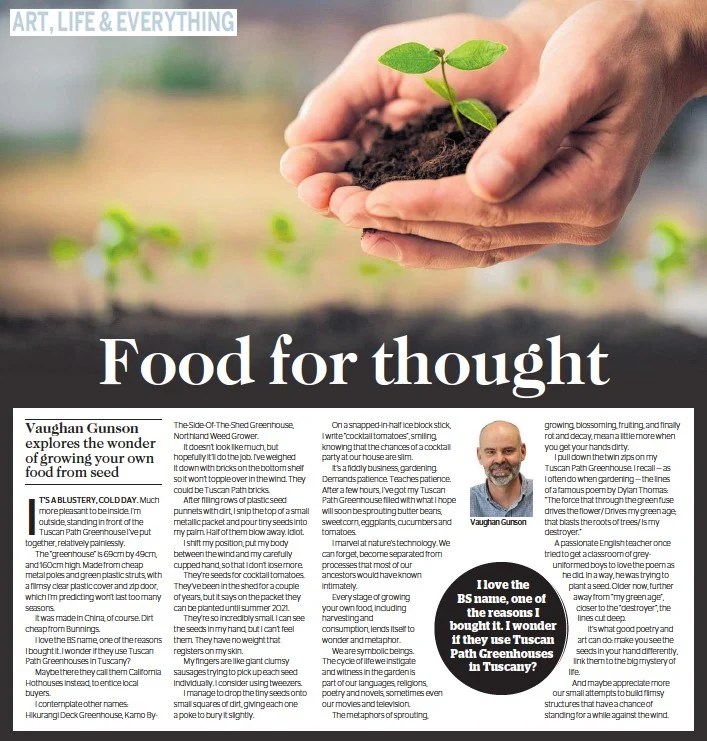
It’s a blustery cold day. Much more pleasant to be inside. Instead, I’m outside, standing in front of the Tuscan Path Greenhouse I’ve put together, relatively painlessly. The “greenhouse” is 69cm by 49cm, and 160cm high. Made from cheap metal poles and green plastic struts, with a flimsy clear plastic cover and zip door, which I’m predicting won’t last too many seasons. It was made in China of course. Dirt cheap from Bunnings. 

I love the bullshit name, one of the reasons I bought it. I wonder if they use Tuscan Path Greenhouses in Tuscany? Maybe there they call them California Hothouses, to entice local buyers. I contemplate other names: Hikurangi Deck Greenhouse, Kamo By-The-Side-Of-The-Shed Greenhouse, Northland Weed Grower. 

It doesn’t look like much, but hopefully it’ll do the job. I’ve weighed it down with bricks on the bottom shelf so it won’t topple over in the wind. They could be Tuscan Path bricks. 

After filling rows of plastic seed punnets with dirt, I snip the top of a small metallic packet and pour tiny seeds into my palm. Half of them blow away. Idiot. I shift my position, put my body between the wind and my carefully cupped hand, so I don’t lose more.

They’re seeds for cocktail tomatoes. They’ve been in the shed for a couple of years, but it says on the packet they can be planted up until summer 2021. They’re so incredibly small. I can see the seeds in my hand, but I can’t feel them. They have no weight that registers on my skin. My fingers are like giant clumsy sausages trying to pick up each seed individually. I consider using tweezers.

I manage to drop the tiny seeds onto small squares of dirt, giving each one a poke to bury it slightly. On a snapped-in-half ice block stick, I write “cocktail tomatoes”, smiling, knowing that the chances of a cocktail party at our house are slim. 

It’s a fiddly business, gardening. Demands patience. Teaches patience. After a few hours, I’ve got my Tuscan Path Greenhouse filled with what I hope will soon be sprouting butter beans, sweetcorn, eggplants, cucumbers and tomatoes. I marvel at nature’s technology. We can forget, become separated from processes that most of our ancestors would have known intimately. 

Every stage of growing your own food, including harvesting and consumption, lends itself to wonder and metaphor. We are symbolic beings. The cycle of life we instigate and witness in the garden is part of our languages, religions, poetry and novels, sometimes even our movies and television. The metaphors of sprouting, growing, blossoming, fruiting, and finally death and decay, mean a little more when you get your hands dirty. 

I pull down the twin zips on my Tuscan Path Greenhouse to close it up. Stepping back, I recall—as I often do when gardening—the lines of a famous poem by Dylan Thomas: “The force that through the green fuse drives the flower/ Drives my green age; that blasts the roots of trees/ Is my destroyer.” A passionate English teacher once tried to get a classroom of grey-uniformed boys to love the poem as he did. In a way, he was trying to plant a seed. 

Older now, further away from “my green age”, closer to the “destroyer”, the lines cut deep. It’s what good poetry and art can do: make you see the seeds in your hand differently, link them to the big mystery of life.

And maybe appreciate more our small attempts to build flimsy structures that have a chance of standing for a while against the wind. 

Standard
Poetry

Once seated

The old purple towel,
faded to dull lilac, placed
on the seat of the bent
picnic table. The grey wood
stained with black mould.
It’s chilly. But there’s sun enough
to sit for awhile. The dogs
in the neighbourhood are barking
like a modern jazz quartet.
The bass hungry, the drums excitable,
the piano just for fun,
the trumpet leading them on.

Standard