
Northern Advocate Column

Shane Carter in Whangarei

30 May 2015

It’s clear to me that Whangarei has reached a cultural high-watermark moment. And it’s nothing to do with the Hundertwasser. It’s not the even the wonderful Hatea Loop Walkway, or indeed the Whangarei Growers’ Market. It’s not the many bustling cafés in this town, one of which I’m currently sitting in writing this piece. No, it’s the prospect of Shane Carter, frontman for the legendary Straitjacket Fits, playing live in Whangarei. I truly never thought I’d live to see the day that I’d be able to see my musical heroes in my own hometown.

The arts and music scene has been bubbling along nicely for a while now, thanks to the efforts of talented and dedicated local people. Many of whom might quite fancy living in the inner suburbs of a bigger city like Auckland, Melbourne or London. But oh well, if you can’t afford it, Whangarei will have to do. Why not try to create something of that big city vibe here.

I have to take my hat off to Jessica White and her team at The Old Stone Butter Factory for the music, performance, comedy, poetry and burlesque that’s being put on for our entertainment pleasure every week. The artists deserve to be supported, to encourage local talent and ensure those from other parts of the country (and overseas) keep coming back. Word is getting around New Zealand musicians that Whangarei now has a great live venue.

On Saturday 13th June when Shane Carter walks on stage with his electric guitar I’ll be very happy I didn’t have to make the trip to Auckland to see him, and that there’ll be people I know in the audience to share the experience with. I’m sure he’ll play classic songs from the late 80s/early 90s era of the Flying Nun label, when New Zealand indie rock bands were as good as any in the world, songs like Dialing a Prayer, She Speeds and Bad Note for a Heart.

As the global rock star he could have been, Carter had it all, good looks, a punk attitude and awesome ability on the guitar. It was the lyrics, though, that raised it to another level, sung by Carter in his sneering voice (think Elvis crossed with Johnny Rotten). Lyrically, he pushed and twisted the conventions of love songs, often dwelling on the darker side of love and obsession. Some songs were deeply mysterious and held together by memorable poetic images, like “No need to fight these things crawling inside/ Like slaters on dead wood/ Nothing’s forever so make sure it’s good” from Headwind, off the powerful and melodious 1991 album Melt.

On the night I’ll be calling out for a song I’ve never heard him play live, Brittle, a bluesy and moody number with a quirky guitar riff. This was the song Straitjacket Fits contributed to the 1993 compilation album No Alternative, produced by the US-based AIDS awareness organisation Red Hot. Other contributors were Smashing Pumpkins, Pavement, Soundgarden, Beastie Boys and Nirvana.   

But no matter what the setlist, I’ll be there dancing joyfully on the inside, imagining I could be in any cool inner city music venue in the world. And yet I’ll be in Whangarei, which will make the night even sweeter.

Standard
Northern Advocate Column

Country music, the stuff of life

18 April 2015

The twangs and rhythms of country music were etched into my childhood. It was on the radio, on the large stereo in the lounge, blasting from speakers, which as a small child were taller than I was. And on TV of course―Dolly Parton, for various reasons, was fascinating, and Kenny Rogers with his immaculately trimmed beard. 

But mostly it was in the backseat of the car on family trips. I remember a six cassette tape set with a title like Country Greats. There was plenty of the polished Nashville sound, but also darker stuff like Johnny Cash’s I Walk the LineAnd songs that told stories of another world, like El Paso by Marty Robbins, which was magic to a kid who loved watching the westerns that screened regularly on TV in the weekends. Here was a mythical America, which through exposure―and the lack of anything else very mythical―meant something to a boy growing up in suburban Whangarei. There was lots I didn’t like. A certain steel guitar sound (you know it) always made me feel a bit sick in the stomach―though that might be my musical memories mixing with my memory of queasiness traveling winding Northland roads.

As a teenager, country music was the antithesis of good music. Never-the-less when at university in Auckland, and delving deep into the alternative music scene, I still thought it would be a good idea to go with my father to see Johnny Cash and June Carter at the Auckland Town Hall. To my surprise it remains one of the best concerts I’ve been to. Great songs, slick musicians and the charisma of Cash and Carter had me hooked. Soon after I discovered Alt Country, with new bands like Uncle Tupelo and Wilco becoming passionate favourites.

The best country music is rooted in the combination of simple rhythms and melodies, with lyrics that are often about sadness, loss and heartache. It’s been said that country music is the blues for white people. It’s that balance between dark and light, joy and sorrow, that makes it sound true. 

So when I found out that New Zealand country music star Tami Neilson was playing at The Old Stone Butter Factory in town I had to go. There were three support acts whose musicianship was equal to the main act. They sung curious original songs that mixed a world and sound from a distant America with observations and experiences of life in this country in the 21st century. I guess love gone wrong is universal. 

Neilson, as one of her songs says, is a dynamite of a woman with a great vocal range. There were sad love songs, but also happy ones belted out to an infectious rockabilly beat that had people up and dancing. 

Surveying the mixture of ages in the audience I wondered how many of the younger crowd had grown up listening to their parent’s country music collections, who once knew all the words to Jolene, singing along in the back of the car on a dusty country road heading on a family summer holiday. The lyrics, a barely understood but intriguing glimpse into a complex adult world of jealously and desire. It’s the stuff of life that never goes away, like country music.  

Standard
Art, Northern Advocate Column

John Foster’s ‘Four Seasons on the Farm’

IMG_1722

4 April 2015

I actually chuckled. That was my initial reaction to running my eyes over John Foster’s large mural with many, many sheep.

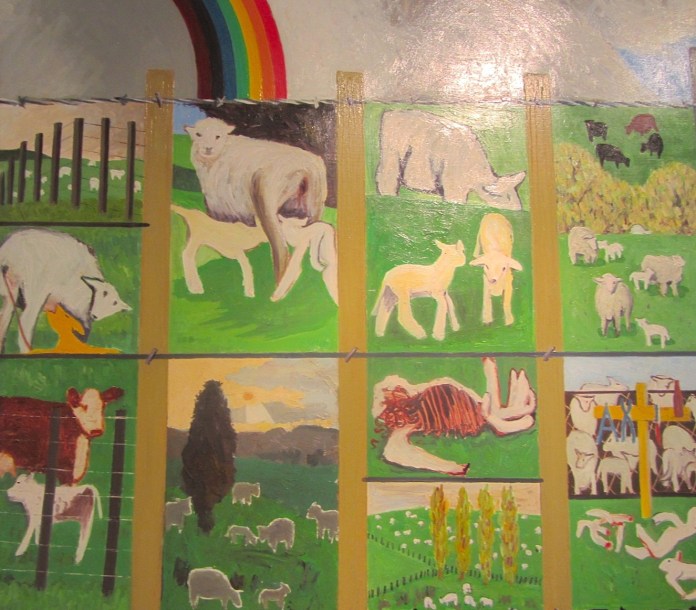
How delightfully incongruous it was to see in the rarefied space of an art gallery something so seemingly mundane as life on a sheep farm. Sheep being sheared, drenched, corralled, giving birth, dying, and just milling about eating grass. 

Four Seasons on the Farm is currently installed at the Whangarei Art Museum. The artist, unsurprisingly, was also a sheep farmer on a property near Wellsford. Foster painted the work, which stretches 14.4 metres, from 1980 to 1984 in a farm shed converted into a studio.

There are 365 panels depicting events and scenes on the farm over the course of the year. Grey fence posts divide the mural into 12 months. The seasons flow from the ochre shades of late summer through to the greening grass of autumn, the greyness and mud of winter, and the rejuvenation of colour in spring and early summer.

Everything you could imagine happening on a farm is represented. It’s a narrative of life and death. In a prominently positioned panel a ram mounts an indifferent looking ewe. In the August section an extended sequence of panels shows the birth of lambs, painted a special golden yellow. 

Further on there’s a panel where lambs have bloodied ears and butts from docking and tagging. Grim, but visually dramatic, as are the pictures of sheep corpses amid scenes of idyllic rural beauty and ever changing weather.

Foster has successfully imbued life on a sheep farm with epic qualities. It’s a bit like Game of Thrones, the beauty and violence, and winter is always coming. The rain-jacketed man on the motorbike a craggy and heroic Warden of the North.

But what kept me engaged with this large work was the way it was painted.  It’s rugged and raw, as befitting its subject matter. The paint is smeared and plastered on.

The scenes are at turn cartoon-like and impressionistic. There’s no refined perspective and detailed shading. Everything is flat on the picture frame and pushing out at you. The influences of New Zealand painters Colin McCahon, Toss Wollaston and Pat Hanly is strong.

My delight in the work undoubtedly comes from the contrast it offers from the images we see on our screens. It’s got to the point that I’ve developed almost a nausea at viewing digital photographs. Such is the saturation that digital imagery has achieved over the last decade. The early 1980s seems like a distant and far simpler age.

And that’s the thing about art, sometimes it develops meaning and importance that could not have been envisaged by the artist. Times change, our experiences change and then shift the way we see things.

I recommend leaving your phones at home and taking the time to go and see Four Seasons on a Farm. Revel in a different visual experience that makes you want to touch, smell and hear the world.

IMG_1720

Standard